
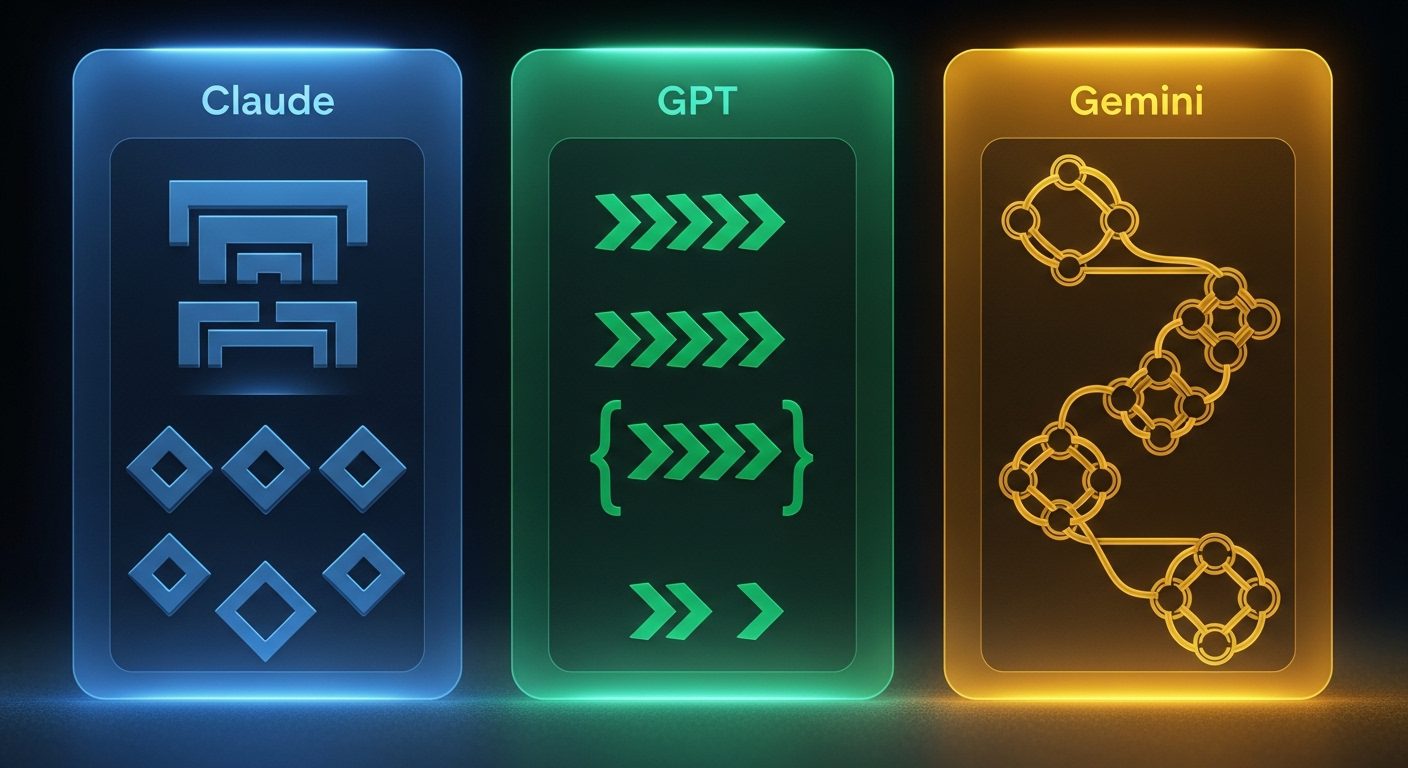
Three AI Giants Walk Into a Prompt — Here’s What Happened
Last Tuesday at 2 AM, I was staring at my screen trying to finish a competitive analysis for a client pitch. Deadline: 9 AM. I had three browser tabs open. ChatGPT in one. Claude in another. Gemini in the third. I fed all three the exact same prompt and hit enter. What came back was so wildly different across the board that I sat there laughing to myself in the dark. That moment pretty much crystallized everything I’ve been thinking about the state of AI in 2026.
Here’s the thing nobody wants to admit. The “which AI is best” debate is fundamentally broken. It’s like asking whether a hammer is better than a screwdriver. Depends on whether you’re dealing with a nail or a screw, right? But people keep asking, so let’s actually break this down with real results instead of vibes.
When I ran that deep research task across all three models, the differences were striking. ChatGPT produced a 36-page report with 25 sources. It included specific, actionable recommendations that actually matched real-world strategies. Not generic fluff. Real stuff you could hand to a CEO. Claude came back with something shorter and more focused. Tight reasoning, clean structure, but it left me wanting more depth. And Gemini? It went absolutely nuclear with a 48-page report packed with 100 sources. Impressive on paper. But the conclusions read like they were written by a committee of consultants who bill by the word. Too verbose. Too corporate.
The coding tests told a completely different story. Claude’s output was clean, dictionary-based, and optimized. The kind of code a senior developer would nod approvingly at during a review. ChatGPT delivered solid, practical solutions with good explanations baked in. Gemini was fast but produced more basic code that lacked the polish of the other two.
So what’s actually going on with these three companies? Each one is making very deliberate bets:
- OpenAI (ChatGPT) is going all-in on being your everyday AI companion. Personal assistance, research, image generation, the whole package. They want to be the default app on your phone.
- Anthropic (Claude) wants to own coding and enterprise. Their first AI conference was entirely dedicated to coding and developers. Claude is still the default model for Cursor, and they keep pushing Claude Code harder every month.
- Google (Gemini) is finally waking up. The sheer number of AI features Google shipped at I/O was honestly incredible. They’re betting on cost-effective models and best-in-class multimodal capabilities with things like Veo 3.
My honest confession? I rarely read deep research reports in full anymore. I skim them, then load them into an AI project to give the model better context for polishing strategy docs and other deliverables. It’s AI helping AI help me. We live in weird times.

The bottom line for this opening salvo is simple. We are genuinely spoiled to have three amazing models competing head to head. Each one has a lane where it dominates. And the smartest move isn’t picking a favorite. It’s knowing which tool to grab for which job. That’s exactly what we’re going to map out in the sections ahead.
The Everyday Companion: Why ChatGPT Wins for Personal Assistance and Deep Research
Let me tell you about the moment ChatGPT became my default daily driver. I was planning a two-week trip to Portugal last month, and I needed help with everything from flight comparisons to restaurant recommendations in Porto to figuring out whether my US phone plan would work there. I threw the same sprawling, messy prompt at all three AIs. Claude gave me a clean but oddly brief response that felt like a travel brochure written by a very polite intern. Gemini dumped a wall of text so dense I needed a second AI just to summarize it. ChatGPT? It gave me a structured, practical itinerary with specific neighborhood suggestions, budget breakdowns, and even a packing list tailored to the weather forecast for my travel dates. It just… got what I actually needed.
That experience pretty much captures why ChatGPT keeps winning the “everyday companion” category. It has this uncanny ability to match the energy and depth of whatever you throw at it. Ask it something casual, and it stays casual. Ask it something complex, and it scales up without drowning you in corporate-speak.
Deep Research: The Sweet Spot Between Too Little and Too Much
This is where things get really interesting. All three models now offer some version of a “deep research” feature, but the outputs are wildly different in practice.
Here’s what actually happened when each model was asked to produce a deep research report on the same topic. Claude came back with a concise but underwhelming result that left you wanting more. Gemini went the opposite direction and produced a 48-page report with 100 sources. Sounds impressive on paper, right? The problem is that the conclusions were too verbose and read like corporate gibberish. You know the type. Lots of words, very little signal.
ChatGPT landed right in the middle with a 36-page report backed by 25 sources. And here’s the kicker: it included specific, actionable recommendations that actually matched real-world strategies the company in question was already pursuing. Things like targeting non-technical users, focusing on speed, and adding integrations. That’s not generic filler. That’s genuinely useful strategic insight.
The Honest Way Most People Use Deep Research
Let’s be real for a second. Almost nobody reads these deep research reports cover to cover. I certainly don’t. What I actually do is skim the report for key insights, then load the whole thing into an AI project as context. From there, I use that context to polish strategy docs, refine presentations, and build other deliverables.
For that workflow, ChatGPT hits the sweet spot perfectly. It gives you enough depth to be genuinely useful as a context source without burying you in noise. Claude’s output is often too thin to serve as a solid foundation. Gemini’s is so bloated that you spend more time filtering out fluff than extracting value.
Why Personal Assistance Is ChatGPT’s Home Turf
Beyond research, ChatGPT just feels more natural for the random, unpredictable stuff that fills your day. Need help drafting a tricky email to your landlord? Meal planning for a picky family? Comparing two health insurance plans? Figuring out why your dishwasher smells weird? ChatGPT handles all of it with a tone that feels like texting a really smart friend.
A few things that give it the edge for daily personal use:
- It’s the most versatile general-purpose assistant of the three, handling everything from quick questions to complex multi-step tasks
- Its responses tend to be practical and action-oriented rather than theoretical
- The mobile app experience is polished and fast, which matters when you’re using it on the go
- It reads the room better than the other two when it comes to matching the complexity of your request
ChatGPT isn’t the best at everything. We’ll get into where Claude and Gemini pull ahead in the next sections. But for that broad category of “I need an AI that just helps me with life,” it’s the one I keep coming back to. And based on its massive user base, I’m clearly not alone in that.
The Code Whisperer: Claude’s Premium Edge in Professional Coding and Writing
Let’s talk about the elephant in the room. If you’ve spent any time in developer circles lately, you’ve probably noticed something: Claude has quietly become the go-to AI for serious coding work. And Anthropic isn’t being subtle about it either. Their first-ever AI conference? Entirely dedicated to coding and developers. That tells you everything about where they’re placing their bets.
Here’s what makes Claude different when you throw real code at it. Ask all three models to solve the same problem and you’ll notice Claude tends to produce cleaner, more dictionary-based approaches. The code is tighter. It’s more optimized. While Gemini often generates solutions through brute force methods with longer outputs, and ChatGPT gives you solid but sometimes generic answers, Claude consistently delivers code that looks like a senior developer wrote it on a good day.
Where Claude Actually Pulls Ahead
The sweet spot for Claude is complex logic and debugging. When you hit a tricky bug that’s been eating your afternoon, Claude is the model that makes fewer errors on those gnarly problems. It’s better at reasoning through edge cases, catching type issues, and producing thorough code reviews that actually help you ship better software.
- Debugging complex issues: Claude catches subtle bugs that other models gloss over
- Code quality and correctness: Cleaner output with better TypeScript strictness and proper typing
- Architectural decisions: When you need to think through system design, not just spit out a function
- Large codebase analysis: Claude handles context-heavy projects with more precision
There’s a reason Claude is still the default model powering Cursor, one of the most popular AI-powered code editors out there. Anthropic is also doubling down with Claude Code, their dedicated coding tool. They’re not just competing in this space. They’re trying to own it.
The Writing Side Nobody Talks About Enough
But coding isn’t Claude’s only trick. On the writing front, Claude produces prose that feels less robotic and more intentional. It picks up on tone faster. It respects your voice instead of steamrolling it with that unmistakable “AI wrote this” energy. For professional content, marketing copy, and creative projects, Claude consistently outputs work that needs less editing before it’s ready to publish.
Now, is Claude perfect? No. When I ran deep research tasks across all three models, Claude actually produced the shortest reports. If you need volume and comprehensive sourcing, it’s not your best bet for that specific job. But when the goal is quality over quantity, when you need writing that sounds like a human actually thought about it, Claude earns its premium price tag.
The “Worth the Premium” Question
At $20/month for the Pro plan, Claude costs the same as ChatGPT Plus. So the premium isn’t really about price. It’s about what you’re optimizing for. If your daily work revolves around writing production code, reviewing pull requests, making architectural calls, or crafting professional content that doesn’t need three rounds of editing, Claude is worth every penny.
The honest take? Claude won’t replace ChatGPT for your random daily questions or research rabbit holes. But sit down to write actual code or craft something that needs to read well? That’s where Claude quietly becomes the best tool in your stack. It’s not the loudest AI in the room. It’s just the one that keeps showing up with the cleanest work.
The Sleeping Giant Awakens: Gemini’s Cost-Effective Power and Multimodal Muscle
Let’s be honest. For a long time, Gemini felt like that kid in class who had every advantage but kept underperforming on test day. Google had the data, the infrastructure, the talent pipeline, and the distribution. And yet, ChatGPT and Claude kept eating its lunch. That era is over.
The sheer number of AI features Google shipped at I/O was staggering. Not incremental updates. Not minor tweaks. A full-on product blitz that made the rest of the industry sit up and pay attention. Gemini has quietly become the most cost-effective model family on the market, and when you pair that with best-in-class multimodal capabilities like Veo 3 for video generation, you start to see why developers building AI products on a budget are flocking to it.
Where Gemini Actually Shines
Speed. That’s the first thing you notice. Gemini consistently delivers the fastest responses of the big three, and it does so while handling a massive context window. If you’re working with large files, long documents, or sprawling codebases, that context window is a genuine competitive edge. It’s not just a spec sheet number. It changes how you work.
Then there’s the multimodal muscle. While ChatGPT dominates image generation (more on that in the next section), Gemini is carving out serious territory in video and real-time information. Need up-to-date search results baked into your AI workflow? Gemini pulls from Google’s search infrastructure in ways the others simply can’t match. It’s like having a research assistant who also happens to run the world’s biggest search engine.
The Deep Research Caveat
Now, Gemini isn’t perfect. When I tested deep research capabilities across all three models, Gemini produced a 48-page report with 100 sources. Impressive on paper. But the conclusions were too verbose and felt like corporate gibberish. Quantity doesn’t equal quality, and this is where Gemini still needs to tighten up. It over-explains, over-qualifies, and sometimes buries the actual insight under layers of filler text.
For coding, the story is similar. Gemini’s code output tends to be functional but less optimized. It leans toward brute force solutions and can produce longer output that lacks the elegance you’d get from Claude. If you’re building something quick and dirty, that’s fine. If code quality and architectural decisions matter, you’ll want to reach for a different tool.
The Budget Play That Actually Works
Here’s where Gemini becomes impossible to ignore. If you’re a startup founder, a solo developer, or anyone building AI-powered products without a massive budget, Gemini’s pricing is wildly competitive. The free tier is genuinely capable. The paid tiers offer serious horsepower without the sticker shock.
- Video generation and multimodal projects: Gemini is your best bet right now, full stop.
- Google ecosystem work (Firebase, Android, Google Cloud): Gemini understands this stack better than the competition.
- Processing very large files or documents: That context window pays for itself.
- Real-time information needs: Google’s search backbone gives Gemini a natural advantage for anything requiring current data.
The bottom line? Gemini is no longer the underdog. It’s the pragmatist’s choice. You won’t get the polished writing finesse of Claude or the all-around personal assistant magic of ChatGPT. But for raw value per dollar, especially if you’re building products or working with video and multimodal content, Gemini is punching harder than most people realize. The sleeping giant didn’t just wake up. It showed up to work.
Image Generation Showdown: ChatGPT Still Blows the Competition Away
Let’s be real for a second. If you’ve used ChatGPT’s image generation feature recently, you know the feeling. You type in a prompt, hit enter, and what comes back genuinely makes you pause. It’s not just “good for AI.” It’s actually impressive. And that gap between ChatGPT and the competition in this specific area? It’s not closing as fast as you’d think.
ChatGPT’s image generation still dominates. That’s not hype or fanboyism. It’s just where things stand right now. The level of detail, the ability to follow complex prompts with multiple elements, the consistency of style across iterations. It all adds up to an experience that regularly blows people away. Whether you’re creating marketing visuals, mocking up product concepts, or just having fun generating Studio Ghibli versions of your dog, ChatGPT handles it with a level of polish that feels almost unfair to the other two.
Where Do Claude and Gemini Stand?
Claude, for all its brilliance in coding and writing, simply isn’t built to compete here. Anthropic has focused their energy on making Claude the go-to for developers and enterprise teams. Image generation hasn’t been their priority, and it shows. You’re not picking Claude for visual work. Period.
Gemini is a more interesting story. Google has been shipping multimodal features at a breakneck pace, and Gemini does have legitimate image generation capabilities. Some sources even point to Gemini as a strong option when you need image generation paired with up-to-date information. But in terms of raw output quality and creative flexibility? ChatGPT still sits on top of the hill.
What Makes ChatGPT’s Image Gen So Good?
A few things set it apart:
- Prompt adherence: Tell it exactly what you want and it actually listens. Complex scenes with specific lighting, multiple characters, and particular art styles come out looking like what you described, not some vague interpretation.
- Iterative refinement: You can go back and forth with ChatGPT, tweaking details without starting from scratch. That conversational loop makes the creative process feel natural.
- Versatility: Photorealistic renders, cartoon styles, infographics, text on images. The range is wild. One prompt can give you a corporate headshot background and the next can produce a watercolor landscape.
Now, should you write off Gemini entirely for visual tasks? Not necessarily. Google’s Veo 3 and their broader multimodal push signal that they’re serious about catching up, especially on the video side. If you’re working on video content or need AI-generated visuals integrated tightly with Google’s ecosystem, Gemini deserves a look.
But if someone puts a gun to my head and asks “which AI do I use right now to generate the best images?” the answer is ChatGPT. It’s not even a tough call. The others have their strengths in other arenas, and we’ll get to that. But for pure image generation in mid-2025, OpenAI is running away with it.
When to Reach for Which AI — A Task-by-Task Breakdown
Alright, enough theory. You’ve read the deep dives on each model. Now you just want someone to tell you what to open when you’re staring at a specific task. I get it. So here’s the no-fluff, task-by-task breakdown based on real usage, not benchmarks nobody actually cares about.
Everyday Questions and Personal Assistance
Reach for: ChatGPT
Planning a trip? Drafting a tricky email to your landlord? Trying to figure out what’s wrong with your sourdough starter? ChatGPT is your go-to. It’s the most polished conversational AI out there, and it handles the random, messy, “help me think through this” moments better than anything else. It just feels like talking to a really smart friend who happens to know everything.
Deep Research and Strategy Work
Reach for: ChatGPT (with a caveat)
ChatGPT hits the sweet spot here. In testing, it produced a 36-page report with 25 sources that included specific, actionable recommendations. Gemini actually generated a longer report (48 pages, 100 sources), but the conclusions were too verbose and read like corporate gibberish. Claude’s output was too short. Here’s the real move though: skim the research report, then load it into an AI project to give your model the right context for polishing strategy docs and other deliverables. That’s how the pros actually use Deep Research.
Professional Coding and Debugging
Reach for: Claude
This one isn’t even close for serious development work. Claude produces cleaner code, better types, and more thorough solutions. When you’re debugging complex issues, making architectural decisions, or doing code review, Claude is worth the premium. There’s a reason it’s still the default model for Cursor, and Anthropic’s first AI conference was entirely dedicated to coding and developers. They’re not messing around. Use Claude when:
- Code quality and correctness matter more than speed
- You’re analyzing large codebases
- You’re stuck on a tricky bug that other models keep getting wrong
- You need to make architectural decisions
Quick Code Solutions and Exploring New Tech
Reach for: ChatGPT
Need a fast, working solution in an unfamiliar language? Want code with solid explanations? ChatGPT has the broadest knowledge across technologies and gives you practical answers fast. It’s the Swiss Army knife of coding assistance. Not always the sharpest blade for any single task, but reliably useful across the board.
Speed-Critical Development and Large File Processing
Reach for: Gemini
Gemini is the fastest responder with the largest context window. If you’re working with Google, Firebase, or Android ecosystems, it’s a natural fit. And if you need to process very large files without hitting token limits, Gemini handles that better than the other two. Plus it’s a capable free option if you’re just getting started.
Creative Writing and Long-Form Content
Reach for: Claude
Claude has a knack for voice and tone that the other models struggle to match. Its writing feels less robotic, more nuanced. If you’re crafting something that needs to sound genuinely human (blog posts, marketing copy, creative fiction), Claude consistently delivers prose that doesn’t make you cringe.
Image Generation
Reach for: ChatGPT
Not much debate here. ChatGPT’s image generation feature still blows the competition away. It’s not just good. It’s regularly jaw-dropping. If visuals are part of your workflow, this is the clear winner.
Video and Multimodal Projects
Reach for: Gemini
Gemini has best-in-class multimodal capabilities, especially with Veo 3 for video. The sheer number of AI features Google shipped at I/O was staggering. If you’re building AI products on a budget or working with video content, Gemini offers the most cost-effective path forward. By far.
Building AI Products on a Budget
Reach for: Gemini
Gemini has the most cost-effective models in the game right now. If you’re a startup founder or indie developer trying to ship an AI-powered product without burning through your runway, Gemini’s API pricing makes it the obvious choice. You can build real products without the sticker shock.
The Quick Reference Cheat Sheet
Save this for later. Seriously.
- Personal assistance and daily tasks: ChatGPT
- Deep research: ChatGPT
- Professional coding and debugging: Claude
- Creative writing: Claude
- Image generation: ChatGPT
- Video and multimodal work: Gemini
- Speed and large context: Gemini
- Budget-friendly AI development: Gemini
The pattern is pretty clear. ChatGPT is your everyday companion. Claude is your specialist for code and writing. Gemini is your budget-friendly powerhouse for scale and multimedia. But the real unlock? You don’t have to pick just one.
The Real Power Move: Using All Three Together Instead of Picking Sides
Here’s the thing nobody in the AI discourse wants to admit: the “which AI is best” debate is fundamentally the wrong question. It’s like asking whether a hammer is better than a screwdriver. You don’t pick one tool and throw the rest in the trash. You build a toolkit.
And right now? We’re spoiled to have three genuinely amazing models competing head to head. The smart play isn’t loyalty. It’s flexibility.
The Multi-Model Workflow That Actually Works
Let me walk you through what a practical multi-AI workflow looks like in the real world. Say you’re building a product strategy doc for a new feature launch. Here’s how you’d actually use all three:
- Start with ChatGPT’s Deep Research to generate a solid market analysis. It hits the sweet spot between Claude’s too-short reports and Gemini’s 48-page corporate gibberish. You get something like a 36-page report with 25 sources and specific, actionable recommendations.
- Load that research into Claude as context for your actual strategy document. Claude’s writing quality and reasoning will turn raw research into polished, professional prose that sounds like a human wrote it. Not a committee of MBAs.
- Use Gemini when you need to process massive amounts of data on a budget, or when you need multimodal capabilities like video analysis with Veo 3. Its cost-effective API pricing makes it the obvious choice for anything you’re building at scale.
That’s not theoretical. That’s Tuesday.
Stop Paying Three Subscriptions (Unless You Need To)
One practical concern people raise is cost. Three separate $20/month subscriptions adds up to $60/month, and most people aren’t going to do that. The good news is you don’t always have to. Each platform has a free tier that covers casual use. The paid tiers only become necessary when you’re pushing the limits of a specific model for professional work.
Think about where you actually spend your time. If you’re a developer who occasionally needs personal assistance, maybe Claude Pro plus ChatGPT Free is your combo. If you’re a content creator on a budget who sometimes codes, Gemini’s free tier plus Claude for those tricky debugging sessions might be the move. There’s also a growing number of platforms that bundle multiple models under one subscription, letting you switch between them based on the task at hand.
The Context-Passing Trick Nobody Talks About
Here’s a workflow hack that genuinely changed how I work. When one AI gives you a good-but-not-great answer, don’t just re-prompt the same model. Take that output and feed it to a different model with instructions to improve it.
Claude wrote clean code but you want better documentation? Pass it to ChatGPT with “add thorough inline comments and a README.” ChatGPT gave you a solid research summary but the writing feels flat? Hand it to Claude with “rewrite this in a more compelling, human voice.” Gemini processed your massive dataset quickly but the conclusions feel generic? Let Claude or ChatGPT sharpen the insights.
Each model has blind spots. But those blind spots rarely overlap. That’s the whole point.
Matching Models to Moments
The real skill in 2025 isn’t prompt engineering for one model. It’s pattern recognition across all three. After a few weeks of using them side by side, you develop an instinct. You just know that this particular problem is a Claude problem, or that question is a ChatGPT question.
Quick mental model to keep in your back pocket:
- Need something fast and broad? Start with Gemini.
- Hit a wall or need precision? Switch to Claude.
- Want a versatile all-rounder with great image generation? ChatGPT is right there.
- Need a different perspective entirely? Try a second model on the same prompt. You’ll be surprised how often a fresh approach cracks the problem.
The people getting the most value from AI right now aren’t the ones who picked a favorite and argued about it on Twitter. They’re the ones who quietly built a workflow that pulls from all three. No tribalism. No brand loyalty. Just results.
Stop Choosing Favorites — Start Building Your AI Toolkit
Look, if you’ve read this far and you’re still trying to crown one AI as “the best,” you’re asking the wrong question entirely. That’s like walking into a hardware store and asking which tool is the best one. A hammer? A screwdriver? It depends on whether you’re hanging a picture or assembling a desk.
The same logic applies here. And honestly, we’re incredibly spoiled right now. Three genuinely amazing models are competing head to head, pushing each other to get better every single week. That competition is a gift to all of us.
So here’s the mental shift I want you to make today. Stop thinking “ChatGPT vs Gemini vs Claude” and start thinking “ChatGPT AND Gemini AND Claude.” Teamwork makes the dream work, and these tools are far more powerful when you treat them as a coordinated squad rather than rival gladiators.
Your Practical AI Toolkit Cheat Sheet
Let me make this dead simple for you:
- For everyday personal assistance and research, reach for ChatGPT. It hits the sweet spot between depth and readability. Its Deep Research reports are detailed enough to be useful without drowning you in corporate gibberish.
- For writing and professional coding, Claude is worth the premium. There’s a reason it’s still the default model for Cursor, and Anthropic’s entire first AI conference was dedicated to developers. They’re not messing around.
- For video, multimodal work, and building AI products on a budget, Gemini is your play. Google shipped a staggering number of AI features at I/O, and their models are by far the most cost-effective in the game right now.
- For image generation, ChatGPT still blows the competition away. Full stop.
The Real Workflow That Actually Works
Here’s what this looks like in practice. You start a project by using ChatGPT’s Deep Research to pull together a solid 36-page report with real sources. Then you load that report into Claude as context and let it polish your strategy docs and refine the writing. Need to build a quick prototype without burning through your budget? Hand it off to Gemini. Need a stunning visual for your pitch deck? Back to ChatGPT for image generation.
Each AI handles the part it’s best at. You get better output in less time. Nobody’s sitting on the bench.
And if paying for three separate subscriptions feels excessive, platforms are already popping up that bundle multiple models under one roof. The point is access, not loyalty.
One Last Thing
The AI landscape is moving at a pace that makes last month’s rankings feel outdated. Gemini is finally waking up. Claude keeps sharpening its coding edge. ChatGPT continues to expand what a personal AI assistant can do. Picking a favorite today means potentially missing out on a breakthrough tomorrow.
Build the toolkit. Use the right model for the right job. And stay curious enough to keep testing all three as they evolve. That’s not just the smart move. It’s the only move that makes sense in a world where AI capabilities are shifting this fast.